

Pickleball Injuries Part 3: Elbow Pain (Tennis Elbow and Golfer's Elbow)
A Light Paddle, A Sore Elbow
Pickleball looks like an easy game on the arm. The paddle is light, the ball is plastic, and the court is small. Yet elbow pain is one of the most common complaints among players, and it tends to arrive quietly: a little ache after a long session, then a sharp twinge when you grip the paddle, then pain when you pick up a coffee cup.
This is part three of a four-part series on pickleball injuries. In part one we covered the most common injuries, a warm-up, and when to get checked. Part two looked at the ankle and Achilles. Today we take a closer look at elbow pain: what is going on inside the elbow, why pickleball provokes it, what to change right away, and how we help.
Tennis Elbow and Golfer's Elbow: What Is Actually Happening
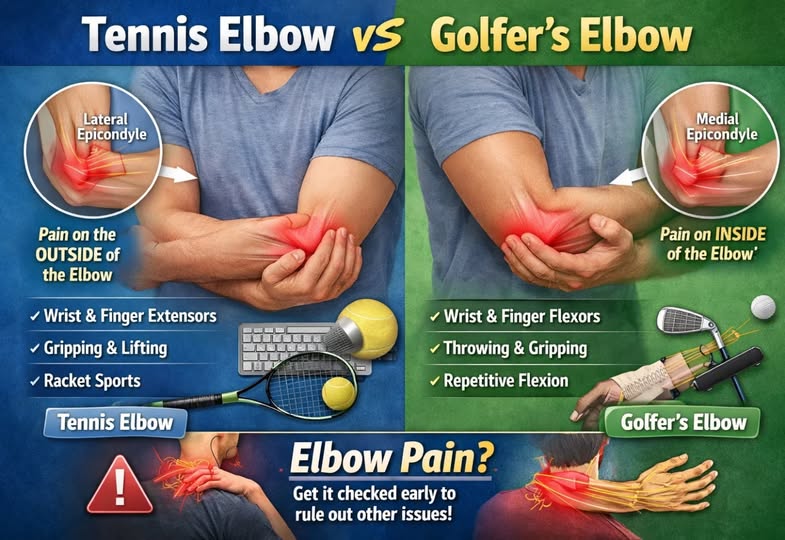
The two conditions are mirror images. Each is a problem with the tendons where the forearm muscles attach at the elbow:
Tennis elbow (lateral epicondylitis) affects the outside of the elbow. It involves the tendons of the muscles that extend the wrist and fingers, the ones you use to hold the paddle firmly and keep the wrist steady on contact.
Golfer's elbow (medial epicondylitis) affects the inside of the elbow. It involves the tendons of the muscles that flex the wrist and grip, and it tends to flare with forehand drives and tight, forceful gripping.
Despite the "-itis" in the name, these are usually not simple inflammation. In most cases the tendon has become irritated and less able to tolerate load, a process called tendinopathy. That matters for treatment: resting alone rarely fixes it, because a tendon that has lost its tolerance needs to be reloaded in a careful, graded way to recover.
Neither condition requires playing tennis or golf. They are overuse problems, and pickleball, with its repetitive gripping, short punch-style swings, and hundreds of contacts per session, is perfectly capable of producing them.
Why Pickleball is Hard on the Elbow
Elbow tendons are not usually hurt by one bad shot. They are worn down by small, repeated stresses that add up, and pickleball offers several of them:
A tight grip. Squeezing the paddle handle hard keeps the forearm muscles working at full effort on every shot, especially for newer players and when defending at the kitchen.
The wrong grip size. A handle that is too small forces you to squeeze harder to control it, and a handle that is too large tires the forearm in a different way.
Paddle weight and balance. A heavy or head-heavy paddle puts more load on the wrist and elbow with every swing.
Wrist-driven shots. Flicking the paddle with the wrist, rather than swinging from the legs, hips, and shoulder, sends the load straight to the forearm tendons.
Off-center hits. Mishits send a jolt of vibration up the arm.
A weak chain. When the shoulder, shoulder blade, and trunk are not doing their share, the forearm works overtime to make up the difference.
Too much, too soon. Going from occasional play to daily play, or adding long drilling sessions, is the most common trigger of all.
Age plays a role too. Tendons become less tolerant of sudden increases in load as we get older, which is why elbow pain shows up so often among new pickleball players in their 40s, 50s, and beyond.
What it Feels Like, and What Else It Could Be
Elbow tendon pain has a recognizable pattern:
A burning or aching pain at the bony bump on the outside (tennis elbow) or inside (golfer's elbow) of the elbow.
Tenderness when you press on that spot.
Pain with gripping, such as holding the paddle, shaking hands, turning a doorknob, or lifting a full coffee cup.
Weakened grip strength.
Stiffness in the morning, and pain that warms up with play but is worse afterward.
Not every sore elbow is a tendon problem, though. Several other things can feel similar:
Neck-related arm pain. A pinched or irritated nerve in the neck can send pain, tingling, or weakness into the forearm and hand. The clues are numbness or tingling, pain that changes with neck movement, or symptoms that do not match the spot where the elbow is tender.
Nerve irritation at the elbow. Pain or tingling along the inner elbow into the ring and little fingers can point to the ulnar nerve, the "funny bone" nerve.
Joint problems. Catching, locking, or a loss of full motion suggests something inside the joint rather than a tendon.
Shoulder and wrist problems that refer pain down or up the arm.
This is one reason an exam matters. Treating the wrong source, however sincerely, does not help, and sorting out the true cause is the first step in fixing it.
What To Do Right Away
The goal is to calm the tendon down without letting the arm go completely idle. Complete rest tends to leave the tendon even less prepared for the day you return.
Cut back, do not necessarily stop. Reduce how often and how long you play, and skip the drills and hard drives that provoke pain. A little discomfort that settles within a day is usually acceptable. Pain that lingers or climbs is not.
Loosen your grip. Try holding the paddle at about a 4 out of 10 in tightness, firm enough to control it and no more.
Check your equipment. Make sure the grip size fits your hand, try a lighter or more evenly balanced paddle, and consider a softer overgrip.
Play from the legs and trunk. Let the hips and shoulder generate the swing, and keep the wrist quiet on contact.
Consider a counterforce strap. A strap worn just below the elbow can take some strain off the tendon during play and daily tasks, and it is a reasonable short-term tool.
Begin gentle strengthening. Slow, controlled exercises such as wrist extension and flexion with a light weight, gradually progressing, help the tendon rebuild its capacity. The exercises should not be sharply painful, and the right dose depends on how irritated the tendon is.
Two things to avoid: repeated cortisone-style fixes as a way to keep playing, and aggressive stretching or deep massage right over the sore spot while it is flared up.
How Chiropractic Care Helps
Like the ankle, the elbow is rarely the whole story. The elbow sits in the middle of a chain that runs from the neck and shoulder blade through the shoulder, elbow, wrist, and hand. When one link is stiff or weak, the elbow often pays for it. Our approach looks at the entire arm and the spine that feeds it.
A thorough exam. We test the elbow tendons and grip strength, and we also assess the wrist, shoulder, shoulder blade, upper back, and neck, to find out where the strain is really coming from and to rule out nerve or joint problems.
Hands-on care. Depending on what we find, this can include joint mobilization or adjusting of the elbow, wrist, shoulder, upper back, and neck, plus soft tissue work for the forearm and surrounding muscles.
Progressive rehab. The tendon heals through a graded loading program, starting with gentle isometric holds and moving to slow strengthening and then to sport-specific movements. We also build the shoulder, shoulder blade, and trunk strength that takes pressure off the forearm.
A return-to-play plan. You return to the court in stages, with clear checkpoints, so you progress as the tendon allows instead of as your schedule demands.
Tendon problems are slow. Most elbow tendinopathy takes weeks to months to settle, and the players who recover best are the ones who start early and stay consistent with the rehab.
When To Come In, and When To Go to The ER
Schedule a visit if:
Elbow pain has lasted more than a week or two or comes back every time you play.
Gripping a paddle, a cup, or a doorknob hurts.
Your grip feels weak, or you have started changing your swing to avoid the pain.
Pain wakes you at night.
You notice numbness or tingling in the forearm or hand, or pain that seems to travel from the neck.
An elbow that has been getting better stalls or gets worse.
Go to The Emergency Room or Urgent Care If:
You fell on the arm and the elbow, forearm, or wrist looks deformed, or a bone is sticking out of the skin.
You have severe pain and rapid swelling after a fall or a hard impact, or you cannot bend or straighten the elbow.
The arm is hot, red, and swollen, especially with a fever, which can signal an infection.
The hand is cold, pale, or blue, or you have sudden numbness or weakness in the arm.
You have chest pain, shortness of breath, or pain spreading to the jaw along with arm pain.
This post is for education and is not a substitute for medical care. If you are not sure whether an injury is an emergency, err on the side of going to the emergency room.
Coming up in part four: the shoulder. Rotator cuff irritation and shoulder impingement are among the most common pickleball complaints, especially on overhead shots and reaches for lobs. We will cover what is happening in the shoulder, what makes it worse, and how to keep it healthy for the long run.
If an elbow is slowing you down reach out to us at Mind Body Spine Chiropractic in Brewster. We would be glad to help you keep playing. Call or text 508-896-7277.


MAP
© 2026 Mind Body Spine Chiropractic. All Rights Reserved. Accessibility Statement - Privacy Policy - Terms and Services - Sitemap
Powered by: 