

Pickleball Injuries Part 2: Ankle Sprains and Achilles Problems
The Injuries That Sideline More Players Than Any Other
If there is one body part that decides how long your pickleball season lasts, it is the ankle, and right behind it is the Achilles tendon. Both take the full force of the quick starts, hard stops, and side-to-side cuts the game demands, and both are routinely asked to do more than they are ready for.
This is part two of a four-part series on pickleball injuries. In part one we covered the most common injuries, a simple warm-up, and when to get checked. Today we take a closer look at ankle sprains and Achilles problems: what is happening in the body, what to do right away, how we help, and how to keep them from coming back.
Ankle Sprains: What Actually Happens
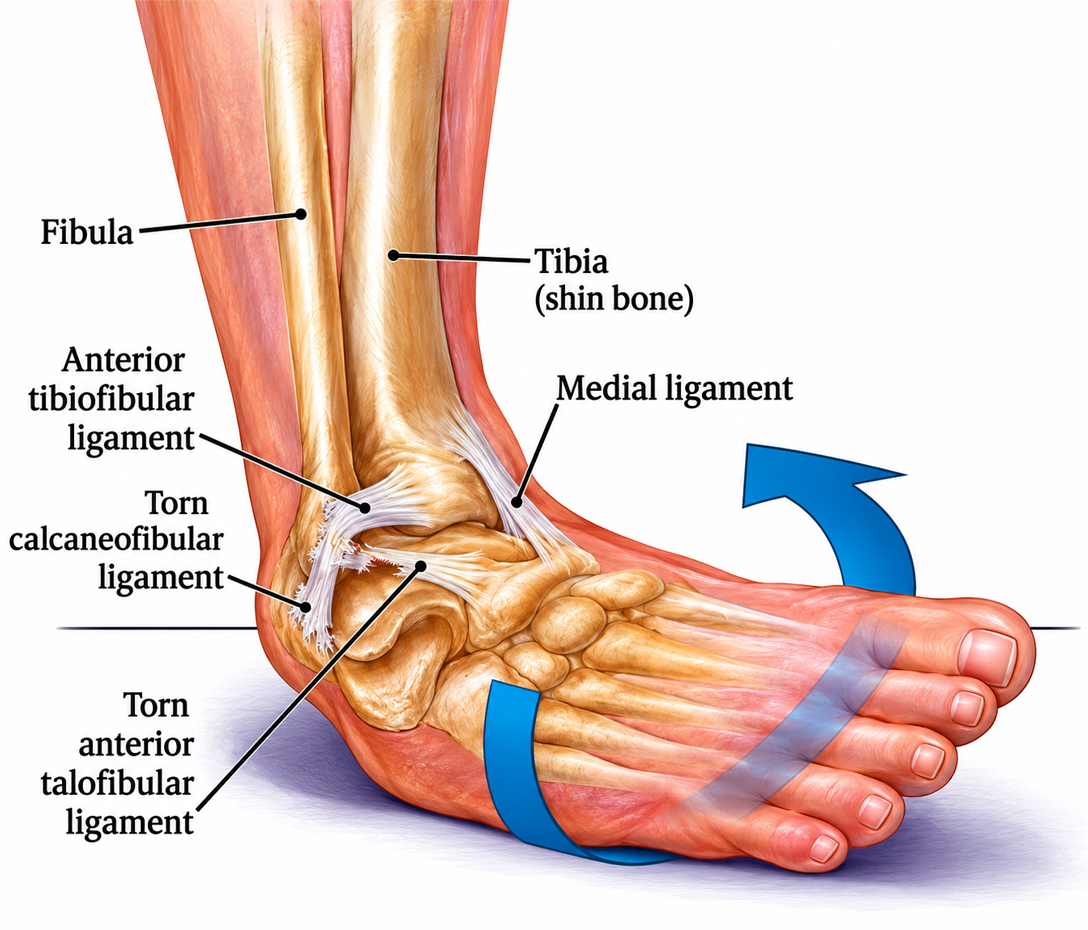
An ankle sprain is an injury to the ligaments, the tough bands that hold the ankle bones together and keep the joint stable. Most pickleball sprains are "inversion" sprains: the foot rolls inward and the ligaments on the outside of the ankle stretch or tear.
On the court, that usually happens in a few familiar ways:
- Cutting hard to the side to reach a wide shot.
- Landing on uneven footing or stepping on a stray ball.
- Coming down on a partner's foot or the edge of the line at the kitchen.
- Backpedaling after a lob and catching a heel.
Sprains are graded by how much of the ligament is damaged:
- Mild: the ligament is stretched. You will have some soreness and mild swelling, and you can usually walk.
- Moderate: a partial tear. Expect more swelling and bruising, tenderness, and a joint that feels loose or painful when you put weight on it.
- Severe: a complete tear. Swelling and bruising are significant, walking is very difficult, and the ankle feels unstable.
The part many players miss is what happens after the swelling goes down. A sprained ankle often loses some of its balance sense and strength, and without rehab it is far more likely to roll again. Repeat sprains are how a one-time injury becomes a chronic, unstable ankle.
Achilles and Calf Problems: The Heel Cord Complains
The Achilles tendon connects your calf muscles to your heel bone, and it carries several times your body weight every time you push off. Pickleball troubles it in three main ways:
- Achilles tendinopathy. An overuse problem that shows up as stiffness and aching in the back of the heel or just above it. It is typically worst with the first steps in the morning and early in a session, may ease as you warm up, and then returns afterward.
- Calf strains. A sudden pull in the calf muscle during a sprint or push-off, often described as feeling like a kick or a snap in the back of the leg. Sometimes called "tennis leg."
- Achilles rupture. A partial or complete tear of the tendon. Players often describe a pop, sometimes with the sensation of being hit in the back of the leg, followed by weakness and difficulty pushing off.
The typical Achilles patient is not an elite athlete. It is a player in their 40s, 50s, or 60s who has taken up an explosive, stop-start sport after a long stretch of lower activity. Tendons lose some of their tolerance for sudden load as we age, and the surrounding calf strength and flexibility matter a great deal. Tight calves, stiff ankles, weak hips, and a sudden jump in how often you play all raise the risk.
The warning sign to take seriously is heel cord pain that keeps returning. Tendinopathy that is ignored does not simply go away, and a tendon that is chronically irritated is more vulnerable to a tear.
The First 72 Hours: What To Do Right Away
What you do in the first few days sets the tone for recovery. For a sprained ankle or a flared-up heel cord, the goal is to protect the area, keep swelling down, and start moving again as soon as it is comfortable.
- Stop playing. Pushing through a fresh sprain is how a mild injury becomes a moderate one.
- Protect it. Take weight off the joint for the first day or two, using a brace or supportive shoe, and crutches if walking is painful.
- Control the swelling. Elevate the foot above heart level when you can and use a light compression wrap. To help ease discomfort, ice for 15 to 20 minutes at a time.
- Start gentle movement early. Within a day or two, once it is comfortable, slowly move the ankle through its range. Gentle pain-free motion tends to heal better than complete immobilization.
- Add weight gradually. Walk as soon as you can do so without limping and build up from there.
Two things to avoid: aggressive stretching of a freshly strained calf or heel cord, and massaging a calf that you suspect has torn. Both can make things worse.
If swelling is not improving after 48 to 72 hours, or the ankle still feels unstable, that is the point to have it examined rather than waiting to see how it goes.
How Chiropractic Care Helps You Get Back on the Court
An ankle or Achilles injury is rarely just an ankle or Achilles problem. The foot, ankle, knee, hip, and low back work together as a chain, and a limitation in one link often explains why another one gave out. Our approach looks at the whole chain, not only the sore spot.
- A thorough exam. We assess the injured area, test ligament stability and tendon strength, and watch how you walk, squat, balance, and push off, to find the cause as well as the symptom.
- Hands-on care. Depending on what we find, this can include joint mobilization and adjusting of the ankle, foot, knee, hip, and spine, along with soft tissue work for the calf and surrounding muscles.
- Rehab that fits the injury. Recovery is not only about calming symptoms. A progressive program of range of motion, calf and foot strength, hip strength, and balance training is what restores the ankle's stability and the tendon's capacity.
- A return-to-play plan. We move you from walking to straight-line movement to lateral cuts and then to play, with clear checkpoints along the way, so you return at full strength instead of just feeling better.
- Footwear and equipment advice. Court shoes, insoles, and bracing can all make a difference, and we will tell you what fits your injury and your game.
If your exam shows a possible fracture, a complete ligament or tendon tear, or anything else that needs imaging or a different kind of care, we will make sure you get to the right place.
Keeping Your Ankles and Achilles Healthy
Here are a few habits to protect these areas well:
- Build calf strength. Slow calf raises, with the knee both straight and bent, load the calf and Achilles in a way that makes them more resilient. Three sets of 10 to 15, a few times a week, is a good start.
- Train balance. Standing on one leg, eyes open and then closed, retrains the small stabilizing muscles around the ankle. Add a pillow or foam pad as it gets easier.
- Strengthen the hips. Weak glutes and hips let the knee and ankle collapse inward during lunges and cuts.
- Keep the ankles and calves mobile. Stiff ankles shift stress to the Achilles and the knee.
- Wear court shoes. Running shoes are designed for forward motion and give less side-to-side support. Replace court shoes when the tread is worn or the sides begin to collapse.
- Warm up every time. The routine in part one takes about seven minutes and includes ankle, calf, and footwork prep.
- Increase play gradually. If you are going from two days a week to five, expect your Achilles to notice. Add one session at a time and give yourself rest days.
- Avoid backpedaling at speed. Turn and shuffle or use a crossover step when chasing a lob.
If you have had a sprain before, bracing or taping for play and a rehab program to rebuild balance and strength are well worth it.
When to come in, and when to go to the ER
Schedule a visit if:
- Your ankle is still swollen, bruised, or painful after 48 to 72 hours.
- The ankle feels loose or unstable or has rolled more than once.
- Heel or Achilles pain keeps returning when you play or is stiff and sore in the morning.
- A calf pull has not improved after a week or so.
- You are limping, or changing how you move, to avoid pain.
Go to the emergency room or urgent care if:
- You cannot put any weight on the foot or take four steps.
- The ankle or foot looks deformed, or a bone is sticking out of the skin.
- You felt a pop in the back of the heel or calf and now cannot rise onto your toes or push off. This may be an Achilles rupture and needs prompt attention.
- You have severe pain directly over the ankle bones or the bones of the foot.
- The calf is hot, red, swollen, and painful, especially with no clear injury. This can signal a blood clot.
This post is for education and is not a substitute for medical care. If you are not sure whether an injury is an emergency, err on the side of going to the emergency room.
Coming up in part three: elbow pain. Tennis elbow and golfer's elbow are as common on the pickleball court as they are on the tennis court and the golf course, and we will cover what causes them, why a paddle and grip change can make a big difference, and what actually helps them heal.
If an ankle or heel is slowing you down, or you want a movement check before the winter season, reach out to us at Mind Body Spine Chiropractic in Brewster. We would be glad to help you keep playing. Call or text 508-896-7277.


MAP
© 2026 Mind Body Spine Chiropractic. All Rights Reserved. Accessibility Statement - Privacy Policy - Terms and Services - Sitemap
Powered by: 